Articulation in Music: How Each Note Starts, Lasts and Connects
Every common articulation mark in one chart, what each one does to a note, how pianists, string and wind players play them, and how MIDI records them
What is articulation in music?
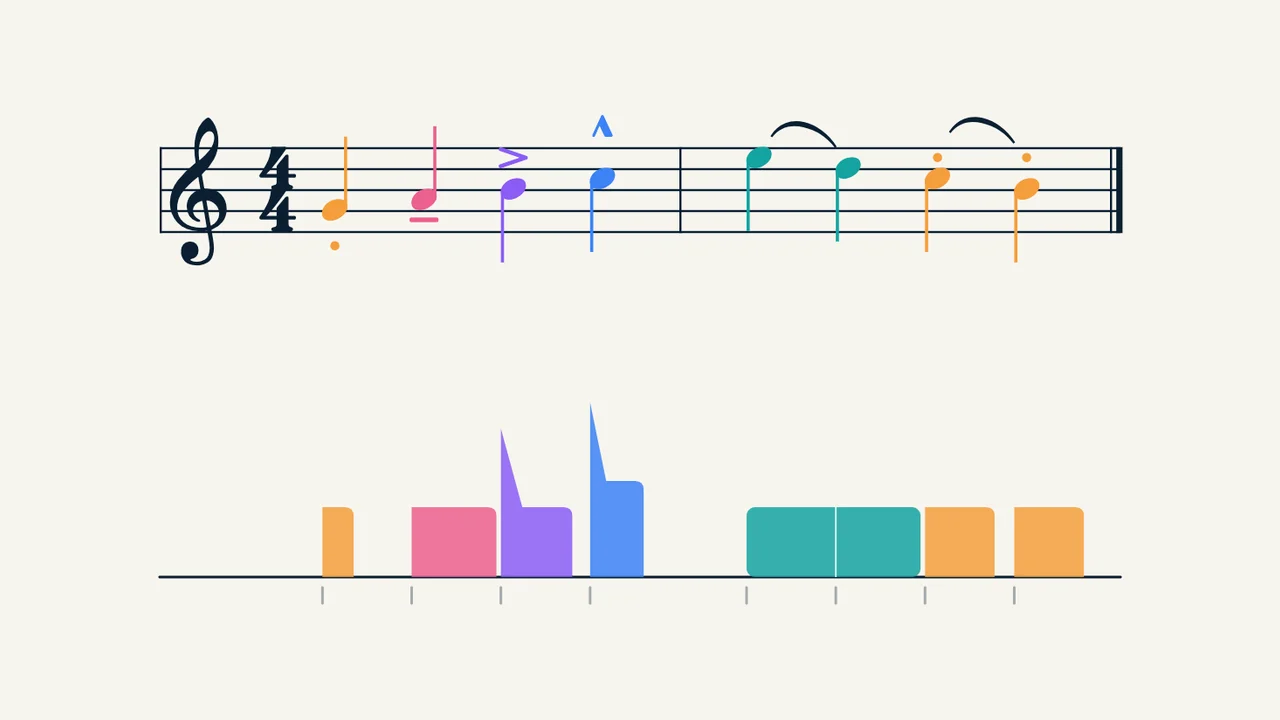
Articulation in music is the way a note is played: how it starts, how long it sounds and whether it connects to the next note. Small marks above or below the notes, such as dots and wedges, tell you which articulation to use. The pitches and the rhythm stay as written.
Play the same five notes short and bouncy, then smooth and joined, and you hear two different melodies built from identical notes. Composers use that contrast on purpose. According to Wikipedia’s article on articulation, Mendelssohn’s Hebrides Overture opens with a theme played legato (smoothly) and later brings the same idea back staccato (detached) as he develops it.
Common lists of the elements of music name rhythm, melody, harmony, texture, timbre (tone color), dynamics, form and tempo. Some lists add articulation as an element of its own; others treat it as part of expression, next to dynamics and timbre.
Articulation vs dynamics vs phrasing
These three all shape how music feels, but they answer different questions:
- Dynamics answer “how loud?” A forte (f) marking covers a whole passage.
- Articulation answers “how does each note start and end?” A staccato dot affects one note.
- Phrasing answers “which notes belong together?” A phrase is a musical sentence, often four or eight bars long.
They overlap at the edges. An accent makes one note louder, which is why some books list accents under dynamics. A long curved line can mark articulation (play smoothly) and phrasing (this is one musical sentence) at the same time.
One thing articulation never changes is where the notes fall. A staccato quarter note still takes a full beat in 4/4. The note sounds for part of the beat, and the rest of the beat is silence. If your staccato notes start to rush, you are cutting the silence short.
Articulation marks chart
These seven marks cover most of what you’ll see in printed music.
| Mark | Name | What it looks like | How it’s played | Where you see it |
|---|---|---|---|---|
| Staccato | staccato (Italian, “detached”) | a small dot above or below the notehead | short, with a gap after it; often taught as about half the written length | everywhere, from beginner piano pieces to orchestral parts |
| Staccatissimo | staccatissimo | a small vertical wedge or teardrop (some editions use a short vertical stroke) | shorter and sharper than staccato | fast, crisp passages |
| Tenuto | tenuto (“held”) | a short horizontal line above or below the notehead | full length, often with a little weight | slow melodies, and single notes inside detached passages |
| Accent | accent | a sideways wedge: > | a stronger attack, then back to the surrounding volume | rhythmic music of all kinds, offbeats |
| Marcato | marcato (“marked”) | an upward wedge: ^, usually written above the note | a strong, hard attack, slightly separated | marches, big-band brass, loud climaxes |
| Legato / slur | legato (“bound together”) | a curved line over or under notes of different pitches, or the word legato | smooth, no gap between notes | melodies, singing lines, string and wind parts |
| Portato | portato, also called mezzo-staccato | staccato dots under a slur, or a dot plus a line on one note | gently separated, often taught as about three quarters of the length | slow, expressive passages |
Dots, lines and wedges sit next to the notehead, usually on the side away from the stem. The lengths in the table (“about half”, “about three quarters”) are teaching conventions, not rules. The tempo and the style of the music decide how short a staccato should be.
Two more signs often appear on articulation charts. The fermata (a dot under an arch) means “pause here and hold the note longer”. The letters sfz (sforzando) ask for a sudden, strong accent. The first is a timing sign and the second a dynamic accent.
Short notes: staccato and staccatissimo
Staccato
Staccato means a note is played short and detached, with a small silence before the next note. Staccato notes sound light and bouncy, like a plucked bass line or a cheerful piano accompaniment.
Don’t confuse the staccato dot with a dotted note. A staccato dot sits above or below the notehead and makes the sound shorter. A rhythm dot sits after the notehead and makes the note longer by half its value.
Staccatissimo
Staccatissimo is “very staccato”: shorter and sharper again, marked with a wedge instead of a dot. You’ll meet it in fast music where each note needs to sound crisp, almost clipped.
Smooth notes: legato and the slur
Legato
Legato is the opposite of staccato: each note is held until the next one begins, so the sound never breaks. The Italian word means “bound together”. Composers write the word legato over a passage, or more often use slurs.
The slur
A slur is a curved line over two or more notes of different pitches. It means “play these notes connected”. A string player plays them in one bow stroke, a wind player tongues only the first note and keeps the air flowing, and a pianist holds each key until the next one is down.
A long curve over a whole musical sentence is usually called a phrase mark. At the end of a slur, players often lift a little before the next note, the way you take a small breath between sentences. The piano’s sustain pedal does not create a slur: it lets notes ring on, but the connected line still comes from the fingers.
Slur vs tie
Slurs and ties look almost the same, so check the pitches. A tie joins two notes of the same pitch: you play the first and hold it for the length of both. A slur joins notes of different pitches, and you play every one of them, smoothly. Ties change how long a note lasts, which the guide to note values and ties explains with examples.
Emphasis marks: accent, marcato and tenuto
Accent
An accent in music tells you to play one note with a stronger attack than the notes around it. The volume rises for the start of the note and falls back to the surrounding level, so an accent in a soft passage is still soft overall. Accents on offbeats are a common way to create syncopation.
Marcato
Marcato means “marked”. It asks for a harder attack than a normal accent, and marcato notes are often played a little detached. You’ll hear them in marches and in brass parts that need to cut through a full band.
Tenuto
Tenuto means “held”: give the note its full length, often with a little extra weight. It works best as a contrast. In a passage of detached notes, a tenuto says “don’t shorten this one”.
Combined articulation marks
Marks can be stacked, and the combinations have their own names.
- Portato (mezzo-staccato): staccato dots under a slur, or a dot and a line on the same note. The notes are slightly separated but still feel connected, often described as about three quarters of their written length. Portato is not the same as portamento, which is a slide in pitch from one note to the next.
- Accent plus staccato: short and strong. Common in rhythmic accompaniments and in fanfare-style brass writing.
- Marcato plus staccato: the hardest, shortest attack on a chart. Use it sparingly, because it sounds aggressive.
How different instruments play articulation
The marks are the same on every instrument, but the technique behind them changes.
Piano. Once a piano key is struck, the note can only fade. That leaves the pianist two controls: how fast the key goes down (a faster key is louder and gives an accent) and when it comes up (staccato or legato). Legato on piano is finger legato: each key stays down until the next one sounds. The sustain pedal makes notes ring but also blurs them together, so pianists still play legato with their fingers when the pedal is down.
Bowed strings. Violinists and cellists articulate with the bow. Slurred notes share one bow stroke. Separate bows (détaché) are not short by themselves; they are just separate. For fast, short notes, players often use spiccato, a bowing where the bow bounces off the string. Spiccato is a technique for playing staccato notes, not a different mark.
Winds and brass. Wind players start notes with the tongue, as if saying “tah” for a clear start or “dah” for a softer one. In a slur, only the first note is tongued and the air carries the rest. Accents get a firmer tongue and a quicker push of air. Very fast passages use double tonguing, alternating syllables such as “tu-ku”.
How MIDI records articulation
MIDI has no staccato or legato message. For each note, a MIDI file or a MIDI keyboard reports when it starts, how hard it was struck and when it stops, plus pedal moves on a separate controller. Articulation lives in that data.
- Note length (the time between note-on and note-off) carries staccato and legato. A staccato note is a short note with a gap after it. A legato line has each note-off arriving as the next note-on starts, or slightly after it, so the notes touch or overlap. Many synthesizers have a legato mode that reacts only to overlapping notes, for example by gliding into the next note instead of restarting it.
- Velocity (1 to 127, sent with each note-on) carries the attack. Accents and marcato notes are higher velocities.
- Controller 64 is the sustain pedal. In the MIDI standard, values from 64 up mean “pedal down”.
Large orchestral sample libraries go a step further: they hold separate recordings of staccato, legato and other articulations, and the player switches between them with special trigger keys outside the playing range, often called keyswitches.
What the MIDI to sheet music converter writes
The MIDI to sheet music converter turns note timing and pitch into notation, but it does not write articulation marks, and it ignores velocity and the sustain pedal. Notes are placed on a sixteenth-note grid, so a short note is written as a shorter note value plus a rest. For example, in a file at 100 BPM (beats per minute), a quarter note played staccato sounds for about 0.3 seconds and comes out as an eighth note followed by an eighth rest. If you want the dots and accents on the page, add them in a notation program after you download the sheet: MuseScore, for example, has an Articulations palette for exactly this.
How to practice staccato and legato
You can hear and feel the difference in a few minutes on the virtual piano. Turn Sustain off first, so the notes stop when you let go.
- Staccato. Play C, D, E, F, G one at a time and let go of each key right after it sounds. Keep a steady beat. The silences should be even, and the notes should not rush.
- Legato. Play the same five notes, holding each key until the next one sounds. On a computer keyboard, press the next key before you release the last. With a mouse, drag from key to key: the piano lets go of one note as the next one starts, so there is no gap.
- Accents. With a mouse or a touchscreen, where you strike the key sets the volume: near the front edge is loud, near the top is soft. Play four notes and accent the first of each group. Computer-keyboard keys always play at the same level, so use the mouse, touch, or a MIDI keyboard (which sends its real velocity) for this step.
- Mix them. Slur two notes, then play two staccato: C–D slurred, E and F short. You’ll meet this “two slurred, two detached” pattern in many beginner pieces.
- Record and listen. Open Record, choose Start recording, play the pattern, stop, and play the take back. Staccato that sounds fine while you play often turns out longer than you thought.
Once the five-note pattern feels easy, try the same articulations on a chord broken into single notes, such as the C major arpeggio.
Before you start any new piece, read the articulation marks the way you read the key signature: first. They tell you what the music should sound like, and it is easier to learn a passage with the right articulation from the start than to fix it later.
Articulation FAQ
What are some examples of articulation in music?
The most common are staccato (short, detached notes), legato (smooth, connected notes), the accent (a stronger attack on one note), tenuto (hold the note for its full value) and marcato (a strong, marked attack). Slurs and portato are also articulations.
What is the difference between staccato and legato?
Staccato notes are shortened, so there is a small silence after each one. Legato notes are held until the next note begins, so the sound never breaks. They are opposites, and many pieces switch between them to create contrast.
What is the difference between a slur and a tie?
A tie joins two notes of the same pitch into one longer note that you play only once. A slur joins notes of different pitches and tells you to play them smoothly connected.
What does staccato mean in music?
Staccato means a note is played short and detached, with a small silence before the next note. It is written as a dot above or below the notehead.
What is an accent in music?
An accent tells you to play one note with a stronger attack than the notes around it. It is written as a sideways wedge (>) above or below the note.