What Is a Triplet in Music? Three Notes in the Time of Two
How long eighth, quarter and half note triplets last, how to count them, how they differ from 6/8 and swing, and how to practice them with a metronome
What is a triplet in music?
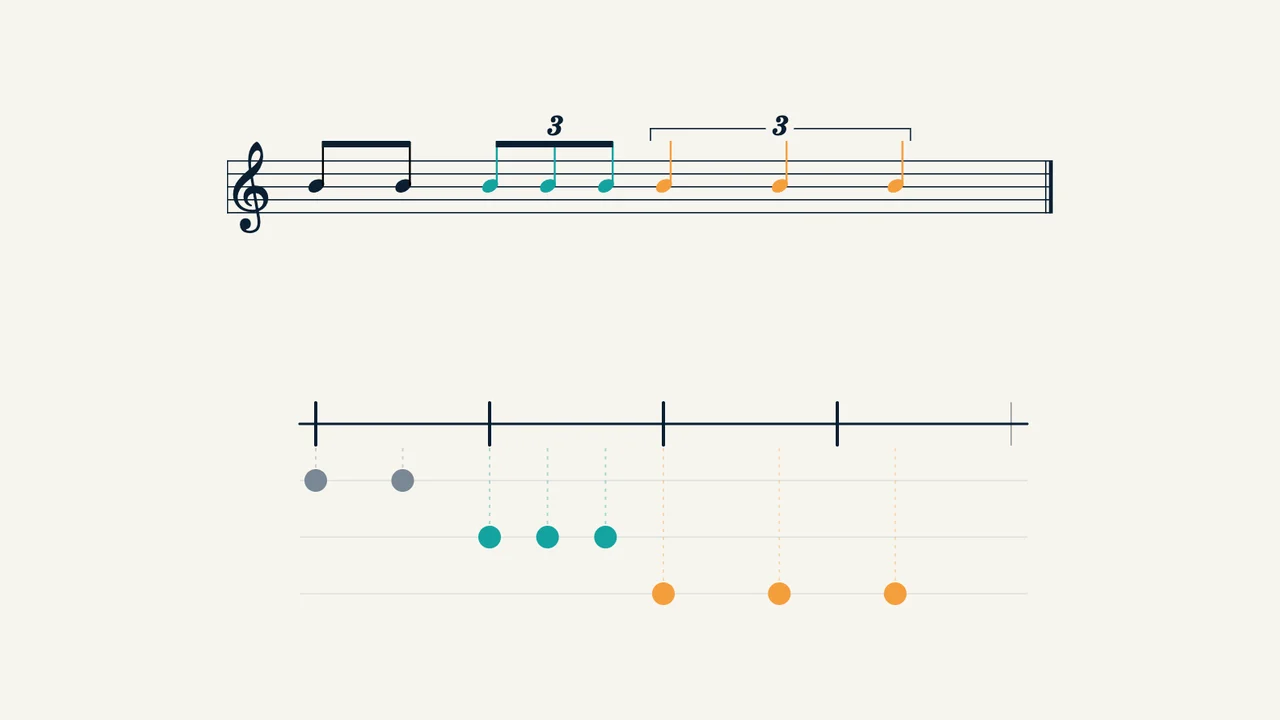
A triplet is three equal notes played in the time that two notes of the same kind would take. Three triplet eighth notes fill the same time as two ordinary eighth notes, which is one quarter note.
Triplets exist because ordinary note values divide by two. A whole note splits into two half notes, a half note into two quarters, and so on down (the full chain is in note values in music). No undotted note value splits a quarter-note beat into three, so music notation borrows the next shorter note and marks the group with a 3.
You can spot a triplet on the page by that number:
- Beamed notes (eighths, sixteenths) carry a 3 above or below the beam.
- Unbeamed notes (quarters, halves) sit under a bracket with the 3 in the middle.
- Older editions sometimes draw a curved line (a slur) with the 3 instead of a bracket. When a piece repeats triplets bar after bar, editors often leave the 3 out after the first few groups.
A triplet doesn’t have to be three identical notes. One of the three can be a rest, and two of them can be joined into a longer note, such as a triplet quarter followed by a triplet eighth. The rule is that the parts add up to three of the triplet’s note value.
Triplets belong to a larger family called tuplets: any group that divides time into a number of parts the time signature wouldn’t give you.
How long does a triplet last?
Each note in a triplet lasts two-thirds of the same note written without the 3. The whole group lasts as long as two of its own notes.
The table assumes 4/4 time with the quarter note as the beat, at 60 BPM (beats per minute), where one beat lasts one second:
| Triplet | Three notes fill the time of | One triplet note lasts | At 60 BPM (normal note) |
|---|---|---|---|
| Sixteenth-note triplet | one eighth note (½ beat) | ⅙ of a beat | 167 ms (250 ms) |
| Eighth-note triplet | one quarter note (1 beat) | ⅓ of a beat | 333 ms (500 ms) |
| Quarter-note triplet | one half note (2 beats) | ⅔ of a beat | 667 ms (1,000 ms) |
| Half-note triplet | one whole note (4 beats) | 1⅓ beats | 1,333 ms (2,000 ms) |
The eighth-note triplet is the one you will meet most. It divides one beat into three, so at 60 BPM you hear three notes per second instead of two.
“How many beats is a triplet?” has no single answer, because it depends on the kind of triplet and on the time signature. In 4/4, an eighth-note triplet takes one beat and a quarter-note triplet takes two. In cut time (2/2), where the half note gets the beat, an eighth-note triplet group takes half a beat. The ratio stays the same in every case: three notes in the time of two.
How to count triplets
Counting triplets means saying three equal syllables per beat, with the beat number on the first one. Musicians use several systems, and any of them works as long as the three syllables are the same length:
| System | One beat of eighth-note triplets | Notes |
|---|---|---|
| Numbers + “trip-let” | 1-trip-let, 2-trip-let | the word itself gives you the three parts |
| ”la-li” | 1-la-li, 2-la-li | open vowels that are easy to say fast |
| ”and-a” | 1-&-a, 2-&-a | the same words many musicians use for 6/8 |
| Words | pine-ap-ple, straw-ber-ry | good for beginners and children |
Avoid “1 e & a” for triplets. Those are four syllables, the count for sixteenth notes, and using them pulls your triplets toward a four-note rhythm.
Quarter-note triplets are harder, because they cross the beat. Count eighth-note triplets over two beats and play on every second syllable:
| Count | 1 | trip | let | 2 | trip | let |
|---|---|---|---|---|---|---|
| Quarter-note triplet | X | X | X |
The second note lands on “let” of beat 1, a third of a beat before beat 2, and the third note lands on “trip” of beat 2. The first note is the one that falls on a beat.
Half-note triplets stretch across a whole bar of 4/4. Count eighth-note triplets for four beats (twelve syllables) and play on every fourth one: “1”, then “trip” of beat 2, then “let” of beat 3.
Sixteenth-note triplets put six notes in one beat. Count them as two sixteenth-note triplet groups, one on the beat and one on the ”&”: “1-trip-let-&-trip-let”.
Triplets vs 6/8 time and dotted rhythms
Triplets and 6/8 time can sound the same. They are two ways of writing a beat that divides into three.
In 6/8, each beat is a dotted quarter note, and a dotted quarter splits into three eighth notes on its own, so no 3 is needed. Sing “Row, Row, Row Your Boat”: every “mer-ri-ly” is three equal notes in one beat. Songbooks usually write the tune in 6/8 with plain eighth notes, but a version in 2/4 with eighth-note triplets would sound the same. The composer picks the time signature that matches how most of the piece divides the beat. A piece whose beat splits in two most of the time and in three now and then is easier to read with triplets.
6/8 has its own mirror image of the triplet, the duplet: two notes in the time of three, marked with a 2.
The choice also tells performers how to feel the music. In the first movement of Beethoven’s “Moonlight” Sonata, the right hand plays triplets throughout, but the movement is written in cut time. The pianist and scholar Donald Francis Tovey warned players not to take it “on a quaver standard like a slow 12/8” (quaver is the British word for an eighth note). The pulse is two slow beats per bar, and each beat holds two triplet groups.
Dotted rhythms are a different thing. A dotted eighth followed by a sixteenth also makes a long-short pattern inside one beat, but the second note comes later:
| Rhythm in one beat | Second note starts at |
|---|---|
| Two eighth notes | ½ of the beat |
| Triplet quarter + triplet eighth (under one 3) | ⅔ of the beat |
| Dotted eighth + sixteenth | ¾ of the beat |
An eighth note followed by two sixteenths also has three notes in one beat, but they are unequal (½, ¼, ¼), so it isn’t a triplet.
Triplet feel: swing and shuffle
A lot of jazz and blues is played with a triplet feel: the eighth notes are written straight but played long-short.
Swing is the best-known case. Swing charts are written in ordinary eighth notes, and the word “Swing” at the top (or the style itself) tells players to play them long-short. Players lengthen the first note of each pair and shorten the second. The usual way to write that out is a triplet quarter plus a triplet eighth, a 2:1 ratio. In real performances the ratio moves around: in jazz it falls somewhere between about 1:1 and 3:1, and players swing wider at slow tempos and closer to even at fast ones.
A shuffle keeps that long-short pattern going on every beat. It is built on the first and third notes of each triplet, with the middle one left out: “1 - let, 2 - let”. Blues shuffles and boogie-woogie piano are the classic examples. Some charts write a shuffle in 12/8, which shows all three parts of every beat.
Triplets in famous music
Two well-known public-domain pieces use triplets almost all the way through:
- Beethoven, Piano Sonata No. 14 (“Moonlight”), first movement (1801). The right hand repeats a triplet figure from the first bar, G♯–C♯–E over a low C♯ in the bass. Those three notes are the C♯ minor chord, played one at a time as an arpeggio, and the slow melody sits on top of the moving triplets.
- Schubert, “Erlkönig” (1815). The piano plays fast triplets, mostly repeated octaves and chords in the right hand, to imitate a horse galloping through the night. The triplets run through the whole song and stop only in the final bars, when the ride ends.
You also hear triplets in drum fills, in the vocal rhythm of a lot of rap, and in the 12/8 grooves of slow blues and soul ballads.
Other tuplets: duplets, quintuplets and more
The triplet is the most common tuplet, and the same idea works with other numbers. The number on the group tells you how many notes to play; convention sets the time they replace:
| Tuplet | Notes | In the time of | Example |
|---|---|---|---|
| Duplet | 2 | 3 | two eighths across a dotted quarter beat in 6/8 |
| Quadruplet | 4 | 3 | four eighths across a dotted quarter beat in 6/8 |
| Quintuplet | 5 | 4 | five sixteenths in one quarter-note beat |
| Sextuplet | 6 | 4 | six sixteenths in one quarter-note beat |
| Septuplet | 7 | 4 (sometimes 8) | seven sixteenths in one quarter-note beat |
A number that could be read two ways gets a ratio instead, such as 7:8 above the group.
Common triplet mistakes
- Fitting a quarter-note triplet into one beat. It spans two beats in 4/4. One beat holds an eighth-note triplet.
- Calling every group of three a triplet. Three beamed eighth notes in 3/8 or 6/8 are ordinary eighths. It’s a triplet only when three notes replace two.
- Mixing up triplets and triple meter. Triple meter (3/4) has three beats per bar. A triplet divides one beat, or a group of beats, into three.
- Rushing the last note. If the third note comes early, the triplet turns into an eighth and two sixteenths. Counting out loud with a click brings it back in place.
How to practice triplets with a metronome
The online metronome can click the triplets for you. Its Subdivision setting has four options: Beats, Eighths, Triplets and Sixteenths.
- Set Time signature to 4/4, the tempo to 60 BPM, and Subdivision to Triplets. Press Start. You hear the beat click plus two softer clicks after it: three clicks per beat.
- Say “1-trip-let, 2-trip-let” with the clicks, then clap or play one note per click.
- Switch Subdivision between Eighths and Triplets while it runs, and play along through each change.
- Once eighth-note triplets feel steady, keep the triplet clicks on and play quarter-note triplets on every second click.
- Use the Speed trainer to raise the tempo a few BPM every few bars.
To hear why triplets and 6/8 sound alike, compare 2/4 at 60 BPM with Triplets against 6/8 at 180 BPM with Subdivision back on Beats. In both, the clicks are 333 milliseconds apart. The accents and the click sounds differ, but the grid is identical.
For 3 against 2, try the virtual drums. Play the kick on every beat with one hand and the hi-hat in quarter-note triplets with the other: three hi-hat hits at equal distances across every two kick beats, with both starting together. The combined rhythm comes out long, short, short, long, the pattern of the phrase “nice cup of tea”.
To hear triplets inside real music, open a MIDI file in the MIDI player and slow it to half speed. At that tempo, you can count each triplet as it goes past.
Triplets FAQ
How many beats is a triplet?
It depends on the kind of triplet. In 4/4, an eighth-note triplet takes one beat, a quarter-note triplet takes two beats and a half-note triplet takes the whole bar. Each group always lasts as long as two of its own notes.
What is a triplet note called?
Each note is named after its value: a triplet eighth note, a triplet quarter note and so on. The general name for any group that divides time into an unusual number of parts is a tuplet, and the triplet is the most common one.
What is the difference between quarter note triplets and eighth note triplets?
Eighth-note triplets put three notes in one beat. Quarter-note triplets put three notes across two beats, so each one lasts twice as long, and only the first falls on a beat.
How do you count eighth note triplets?
Say three equal syllables per beat with the beat number first, such as “1-trip-let, 2-trip-let” or “1-la-li, 2-la-li”. A metronome with a triplet subdivision helps you keep the three notes even.
Are triplets the same as 6/8 time?
They can sound the same, because both divide a beat into three. In 6/8 the beat is a dotted quarter that splits into three eighths on its own; triplets borrow that three-way split inside a time signature whose beat splits in two.