What Is a Clef? Every Music Clef Explained
Treble, bass, alto, tenor and the rarer clefs: the note each one marks, who reads it, and where middle C sits
What Is a Clef?
A clef is the symbol at the start of every staff that tells you which note each line and space stands for. Without a clef, the five lines of a staff have no pitch at all. Take a note on the second line from the bottom: under a treble clef it is G, under a bass clef it is B.
The word comes from French, where clef means “key”. All the clefs in music do that one job: they unlock the staff. You will always find it first on the line, before the key signature and the time signature, and it is printed again at the start of every new line of music.
Keep the clef and the key signature apart in your head. The clef fixes which note sits on which line. The key signature, the sharps or flats right after it, tells you which of those notes to raise or lower. Pitch is one of the elements of music, and the clef is how written music pins it down.
Why Music Needs More Than One Clef
A staff holds about eleven notes on its own: five lines, four spaces between them, and the space above and below. Instruments cover far more than that. For notes outside the staff, music adds short extra lines called ledger lines, and after two or three of them the notes get hard to read at a glance.
Each clef slides the staff up or down to a different part of the range, so an instrument’s notes land on the staff instead of on a ladder of ledger lines. Here is the difference in numbers. The cello’s lowest note, the open C string (C2), sits on the second ledger line below a bass-clef staff. Written under a treble-clef staff, the same note would need eight ledger lines.
The same logic explains why parts change clef partway through a piece. When a cello or bassoon line climbs high, the part switches from bass clef to tenor clef (and on to treble for the cello), then switches back when the line comes down. A clef change in the middle of a line is printed smaller. When the change falls at the start of a new line, the new clef also appears at the end of the line before, as a warning.
The Three Clef Symbols: G, F and C
Every clef that sets a pitch is one of three letters, drawn so that it points at one line of the staff and names it.
| Symbol | Started life as | How it marks its line | The note on that line |
|---|---|---|---|
| G clef | the letter G | the inner curl wraps around the line | G above middle C (G4) |
| F clef | the letter F | the two dots sit above and below the line | F below middle C (F3) |
| C clef | the letter C | the notch where the two curves meet points at the line | middle C (C4) |
In medieval chant books, scribes wrote one of these letters at the start of a staff line to show its pitch. Over the centuries the handwritten letters turned into the symbols printed today, which is why the treble clef still hides a G and the bass clef a rounded F.
The symbols can move. Put the same C clef on a different line and that line becomes middle C, which gives you a different clef with a different name. That is where the alto, tenor and other C clefs come from.
The Four Clefs You Will Read Most
Treble and bass clef cover most of the music you will meet. Alto and tenor are the two C clefs still in daily use. In the lists below, lines and spaces run from the bottom of the staff up, with octave numbers (middle C = C4).
Treble clef (G clef on the second line)
The most common clef. It is used for high instruments and voices and for the right hand in piano music.
- Lines: E4, G4, B4, D5, F5, remembered as “Every Good Boy Does Fine”
- Spaces: F4, A4, C5, E5, which spell FACE
Bass clef (F clef on the fourth line)
The clef for low instruments and voices and for the left hand in piano music.
- Lines: G2, B2, D3, F3, A3, remembered as “Good Boys Do Fine Always”
- Spaces: A2, C3, E3, G3, remembered as “All Cows Eat Grass”
Alto clef (C clef on the middle line)
The home clef of the viola. Middle C sits on the third line, right in the centre of the staff.
- Lines: F3, A3, C4, E4, G4
- Spaces: G3, B3, D4, F4
Tenor clef (C clef on the fourth line)
Used for the high register of the cello, bassoon, trombone and euphonium. Middle C sits on the second line from the top.
- Lines: D3, F3, A3, C4, E4
- Spaces: E3, G3, B3, D4
The C clefs reuse mnemonics you already know
You do not need new memory tricks for alto and tenor. The letters match the ones from treble and bass:
| Clef | Notes | Built from |
|---|---|---|
| Alto lines | F A C E G | treble-clef spaces (FACE) + G |
| Alto spaces | G B D F | bass-clef lines without the last A |
| Tenor lines | D F A C E | D + FACE |
| Tenor spaces | E G B D | treble-clef lines without the last F |
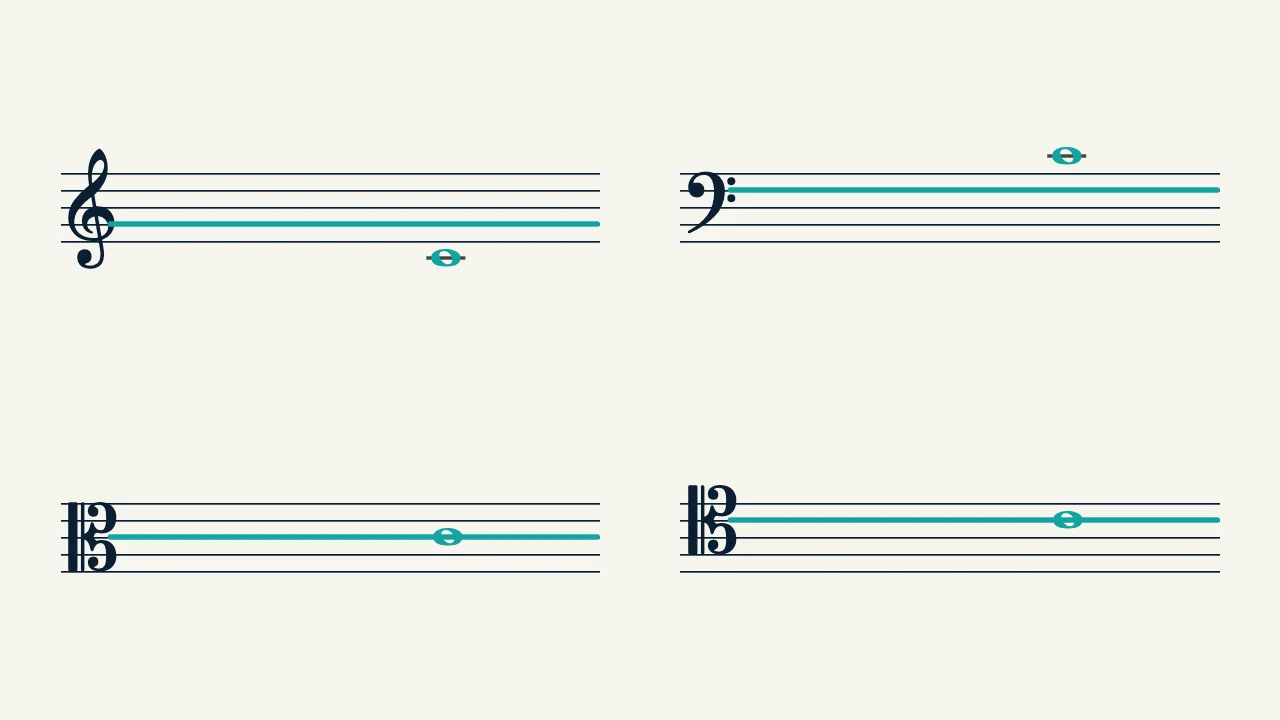
Where Middle C Sits in Every Clef
Middle C (C4) ties all the clefs together. Find it first and you can count your way to any other note.
| Clef | Where middle C is written |
|---|---|
| Treble | first ledger line below the staff |
| Bass | first ledger line above the staff |
| Alto | third line (the middle line) |
| Tenor | fourth line |
| Soprano | first line (bottom line) |
| Mezzo-soprano | second line |
| Baritone | fifth line (top line) |
| French violin | second ledger line below the staff |
| Sub-bass | second ledger line above the staff |
To hear where these notes live, open the virtual piano, turn on note names and find C4 near the middle of the keyboard. Play the treble and bass notes listed earlier and you will hear the two clefs meet at that one key.
The grand staff
Piano and harp music use two staves at once: treble clef on top, bass clef below, joined at the left by a brace. This pair is called the grand staff. Middle C sits between the two staves on its own ledger line, and it can be written in either one: below the treble staff or above the bass staff. The right hand plays the upper staff and the left hand the lower one.
All the Clefs: Nine Positions and Two Special Signs
Place the G, F and C symbols on every line where musicians have used them and you get nine different clefs. Lists of “seven clefs” name treble, bass, soprano, mezzo-soprano, alto, tenor and baritone. The French violin and sub-bass clefs bring the total to nine.
| Clef | Symbol and line | Lines, bottom to top | Where you will see it |
|---|---|---|---|
| French violin | G clef, line 1 | G4 B4 D5 F5 A5 | French violin and flute music of the 1600s and 1700s |
| Treble | G clef, line 2 | E4 G4 B4 D5 F5 | almost everywhere |
| Soprano | C clef, line 1 | C4 E4 G4 B4 D5 | older vocal and keyboard music, some solfège courses |
| Mezzo-soprano | C clef, line 2 | A3 C4 E4 G4 B4 | older vocal music |
| Alto | C clef, line 3 | F3 A3 C4 E4 G4 | viola |
| Tenor | C clef, line 4 | D3 F3 A3 C4 E4 | high cello, bassoon, trombone |
| Baritone | C clef on line 5, or F clef on line 3 | B2 D3 F3 A3 C4 | older vocal music |
| Bass | F clef, line 4 | G2 B2 D3 F3 A3 | almost everywhere |
| Sub-bass | F clef, line 5 | E2 G2 B2 D3 F3 | rare, very low parts in older music |
Some combinations are missing on purpose. A G clef on the third line, for example, gives the same note layout as the soprano clef, so it never needed its own name.
Octave clefs
A small 8 under the treble clef means the music sounds an octave lower than written. Guitar music and tenor vocal parts use it, because both sound below the treble staff but are easier to read on it. An 8 above the clef means an octave higher, and the same idea works with the bass clef.
Neutral clef and TAB
Two signs sit where a clef goes but do not set any pitch. The neutral clef, two short vertical bars, is used for drums and other unpitched percussion: each line or space stands for an instrument, such as the snare or the bass drum. TAB, for guitar and bass, turns the lines into strings and the numbers on them into frets.
Which Instruments Read Which Clef
Most instruments live in treble or bass clef. A few switch clefs as they climb.
| Instrument or voice | Clef |
|---|---|
| Piano, harp | grand staff (treble + bass) |
| Organ | grand staff plus a third staff for the pedals, in bass clef |
| Violin, flute, oboe, clarinet, saxophone, trumpet | treble |
| Guitar | treble, often with the 8 below; it sounds an octave lower than written |
| Viola | alto, with treble for high passages |
| Cello | bass, with tenor and treble higher up |
| Bassoon, trombone | bass, with tenor higher up |
| Double bass, bass guitar | bass; both sound an octave lower than written |
| Soprano and alto voices | treble |
| Tenor voice | octave treble clef, or bass clef when tenors share a staff with basses |
| Baritone and bass voices | bass |
| Drum kit and unpitched percussion | neutral clef |
How Notation Software and MIDI Converters Choose a Clef
Notation editors such as MuseScore and Dorico set the clef from the instrument you add: pick a cello and the staff opens in bass clef, pick a viola and you get alto. You can change it, or insert a clef change partway through a part.
A MIDI file is a different case. It stores which notes play, when and how hard, and nothing about clefs. Any program that turns MIDI into sheet music has to choose a clef by looking at the pitches.
The Tuneonmusic MIDI to sheet music converter uses a simple rule. For each part it sorts every note by pitch and takes the one in the middle (the median): at or above middle C, the part goes in treble clef; below middle C, bass clef. A piano part stored on a single track is split across a grand staff at middle C, or at C3 or C5 if you choose a different hand split.
That rule has limits worth knowing. The converter writes only treble and bass clef, with no alto, tenor or octave clefs. A viola part will come out in treble or bass instead of alto. A guitar part is stored in MIDI at the pitch it sounds, so it can land an octave below where guitar music is written, sometimes in bass clef. If you need the clef your instrument reads, open the result in a notation editor and change it there.
How to Read Any Clef in Three Steps
- Name the symbol. A curl means G, two dots mean F, a notched bracket means C.
- Find its line. That line is G4, F3 or middle C.
- Count by step. Each line or space up is the next letter (A to G, then A again); each one down is the letter before.
Once you can name a note this way, its shape tells you how long to hold it, which is what note values are about. Start with the clef your instrument reads. Pianists learn treble and bass together, and the middle C table above is the fastest way to connect them.
One last habit worth keeping: when a written part looks far too low or far too high, check the clef before you check the notes. The same dot on the same line is a different note in a different clef.
Frequently Asked Questions
What are the four main clefs?
Treble, bass, alto and tenor. Treble is a G clef and bass is an F clef; alto and tenor are C clefs that put middle C on the middle line and on the fourth line.
How many clefs are there in music?
There are three clef symbols (G, F and C) used in nine positions. Lists of seven clefs count treble, bass, soprano, mezzo-soprano, alto, tenor and baritone; the French violin and sub-bass clefs make nine. The neutral clef and TAB sit in the clef’s place but do not set a pitch.
Why is it called a clef?
Clef is French for “key”. The symbol is the key that tells you how to read the lines and spaces of the staff.
What two clefs make up the grand staff?
The treble clef on the upper staff and the bass clef on the lower staff, joined by a brace. Middle C sits between them on a ledger line.
What clef does guitar use?
Treble clef, often with a small 8 under it. Guitar sounds an octave lower than written either way.
Which clef should I learn first?
The clef your instrument reads: treble for most high instruments and voices, bass for low ones. Pianists learn treble and bass together, starting from middle C.