What Is an Arpeggio? A Chord Played One Note at a Time
What the word means, how to build one from any chord, where it shows up in real music and how to play it on piano
What is an arpeggio?
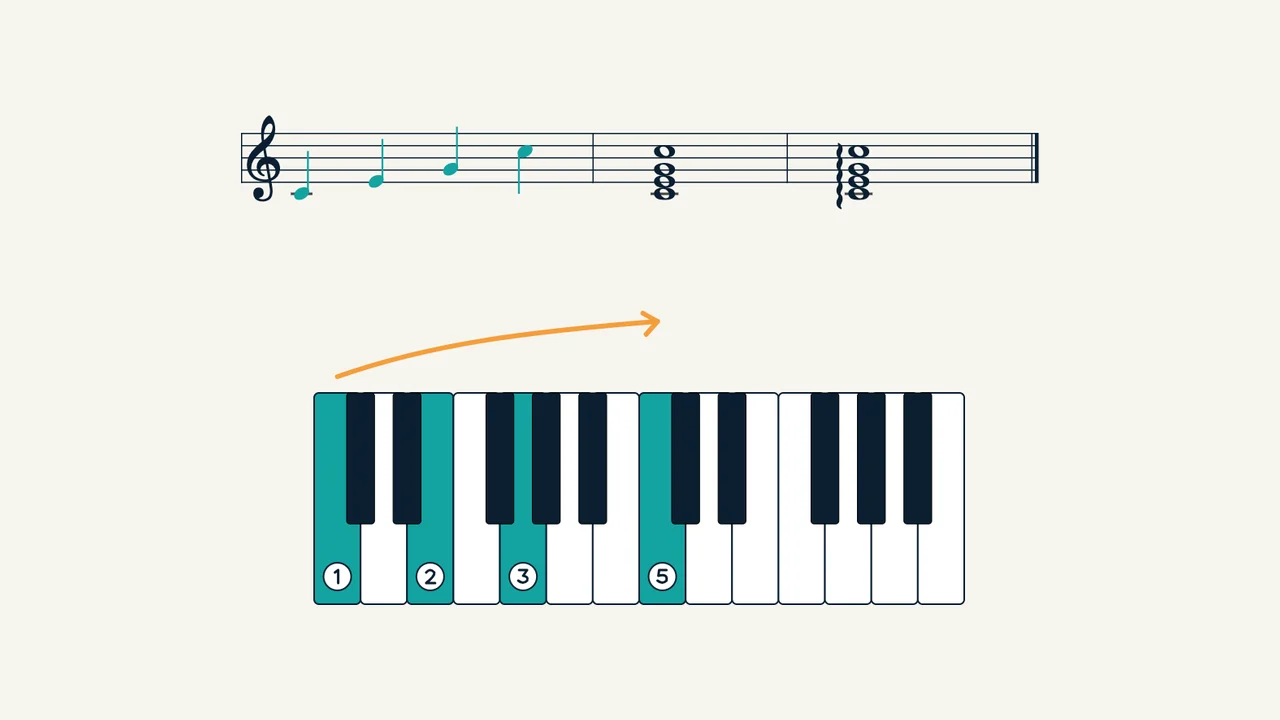
An arpeggio is a chord played one note at a time, most often from the lowest note up or from the highest note down, instead of all the notes together. Take the C major chord (C, E and G): played as an arpeggio, it becomes C–E–G–C, one note after another.
The word is Italian. It comes from arpeggiare, “to play on the harp” (arpa means harp), because a harpist plucks the strings of a chord one by one. In English it is pronounced ar-PEJ-ee-oh, and the plural is arpeggios (Italian uses arpeggi).
You hear the difference straight away. Open the piano chord finder, pick C major, and press Play: the three notes sound together as a block. Press Arpeggio and the same notes sound one at a time from the bottom. The chord stays the same, and the timing is what changes.
Arpeggios are everywhere: in piano accompaniments, guitar picking patterns, bugle calls, video game music and the warm-ups that piano and violin students play every day. Once you can spot them, you start hearing them in a lot of the music you already know.
How to build an arpeggio from any chord
To turn any chord into an arpeggio, list the chord’s notes from the bottom up, play them in order, and add the bottom note (the root) again an octave higher at the top. Coming back down, reverse the order.
| Chord | Chord notes | One-octave arpeggio (up) |
|---|---|---|
| C major | C, E, G | C–E–G–C |
| A minor | A, C, E | A–C–E–A |
| G major | G, B, D | G–B–D–G |
| F major | F, A, C | F–A–C–F |
| G7 (dominant seventh) | G, B, D, F | G–B–D–F–G |
| Cmaj7 (major seventh) | C, E, G, B | C–E–G–B–C |
| B diminished seventh | B, D, F, A♭ | B–D–F–A♭–B |
A few things follow from this:
- An arpeggio has at least three different notes. Two alternating notes are a trill or a tremolo, not an arpeggio.
- Three-note chords (triads) give four-note arpeggios in one octave (three chord notes plus the root on top). Seventh chords give five.
- Direction is free. Up, down, or up and back down are all arpeggios.
- Range is free too. Over two octaves, C major becomes C–E–G–C–E–G–C. Pianists often practice them over two or four octaves.
The chord’s quality changes the sound. A major arpeggio sounds bright and settled, a minor one darker, and a diminished seventh tense, as if it wants to move somewhere else.
Arpeggio vs chord, broken chord and scale
An arpeggio uses the same notes as its chord, played at different moments. A scale uses different notes: it fills in every step between the chord notes.
Chord vs arpeggio. In a chord, the notes start together. In an arpeggio, they start one after another, and they may ring on and overlap (on a piano with the sustain pedal down) or stop before the next one (played short). Your ear still hears the harmony, which is why a fast arpeggio can stand in for a chord.
Broken chord vs arpeggio. The term “broken chord” has two meanings, and that is where most of the confusion comes from:
- In everyday use, a broken chord is any chord split into separate notes. In that sense every arpeggio is a broken chord.
- In a stricter sense, used by many piano teachers and by exam books that list scales, arpeggios and broken chords as separate items, an arpeggio runs straight through the chord notes, up one or more octaves and back down. A broken chord splits the chord into a short shape that turns back on itself and repeats, such as C–G–E–G.
Scale vs arpeggio. The C major scale walks through every step: C–D–E–F–G–A–B–C. The C major arpeggio jumps between chord notes: C–E–G–C. The arpeggio covers the same octave with half the notes, which is why it sounds wider and more open.
| Notes of C major | Timing | Example | |
|---|---|---|---|
| Chord | C, E, G | together | C+E+G struck at once |
| Arpeggio | C, E, G | one at a time, in order | C–E–G–C |
| Broken chord (stricter sense) | C, E, G | one at a time, in a repeating shape | C–G–E–G |
| Scale | all seven notes of the key | one at a time, by step | C–D–E–F–G–A–B–C |
Arpeggios in real music
Arpeggios and broken-chord figures run through classical music, folk songs and anthems. These five examples are all in the public domain, and each one shows a different use.
Bach, Prelude in C major (BWV 846). The first piece in The Well-Tempered Clavier, Book I (1722), is built bar by bar from broken chords. The first bar is C major: C–E–G–C–E, then G–C–E, and that eight-note figure repeats to fill the bar. Almost every following bar does the same with a new chord, so the harmony changes bar by bar while the pattern stays put. In the stricter sense it is a broken-chord pattern, because the figure turns back down before it repeats.
Beethoven, “Moonlight” Sonata (Op. 27 No. 2), first movement. The right hand plays G♯–C♯–E over and over above a low C♯ in the bass. Those three notes are the C♯ minor chord, starting from G♯. They are grouped in threes, as triplets, and the repeating figure gives the movement its slow, rocking feel.
Alberti bass. A left-hand pattern that plays a chord low–high–middle–high: for C major, C–G–E–G. It is named after the Italian composer Domenico Alberti, and you hear it at the start of Mozart’s Piano Sonata in C major, K. 545, under the right-hand melody. In the stricter sense it is a broken chord, since the line turns back on itself.
Taps. The American bugle call uses only four notes: written in C, they are G, C, E and the G above, the notes of a C major chord. A bugle has no valves, so it can only play the natural notes of its tube, and in its playable range those notes spell out one major chord. Arpeggio shapes are what the instrument is built for.
“The Star-Spangled Banner.” The US anthem opens with an arpeggio. In C, “O-oh say can you see” runs down G–E–C and back up E–G–C.
Arpeggios also shape melodies. A tune that jumps between chord notes sounds strong and clear, and you can use the same trick when you write a melody of your own.
How arpeggios are written in sheet music
Most arpeggios are written out note by note, like any other melody: the chord notes appear one after another on the staff, often joined by beams.
A rolled chord is the exception. It is written as a normal chord with a wavy vertical line in front of it. The wavy line tells you to spread the notes fast from the bottom to the top, so the chord ripples instead of landing at once, like a harp. If the composer wants the roll from the top down, an arrow pointing down is added to the end of the line. Some scores write the Italian word arpeggiando or arpeggiato instead.
How to play an arpeggio on piano
On piano, the main skill is moving the hand across more keys than five fingers can cover. These fingerings are for C major (1 is the thumb, 5 the little finger). Other chords use the same idea, but the thumb lands in different places.
One octave (C–E–G–C)
- Right hand: 1–2–3–5 going up, 5–3–2–1 coming down.
- Left hand: 5–4–2–1 going up, 1–2–4–5 coming down.
Two octaves (C–E–G–C–E–G–C)
- Right hand: 1–2–3–1–2–3–5. After finger 3 plays G, the thumb passes under the hand to play the next C.
- Left hand: 5–4–2–1–4–2–1. After the thumb plays C, finger 4 crosses over it to play the next E.
Notice that the right hand skips finger 4 and the left hand skips finger 3. A few tips help the notes sound even:
- Keep the wrist level and let the forearm glide sideways, so the thumb never has to jump.
- Start the thumb moving early, while fingers 2 and 3 are still playing.
- Listen for a bump at the thumb note. If you hear one, slow down.
You can try both fingerings on the virtual piano with your computer keyboard or a MIDI keyboard.
Arpeggios on guitar and other instruments
Every instrument can play arpeggios.
- Guitar: hold a chord shape and pick the strings one at a time instead of strumming. Fingerstyle patterns are arpeggios, and sweep picking (one fast stroke across several strings) plays rapid arpeggios in rock and metal solos.
- One-note instruments: a trumpet, flute or singer can only play one note at a time, so arpeggios are how they outline a chord.
- Early video game music: sound chips had few voices (the Commodore 64’s SID chip had three), so composers played chords as fast arpeggios to save voices for the bass and drums. That shimmering sound became part of the chiptune style.
Arpeggio vs arpeggiator
An arpeggio is the musical figure. An arpeggiator is a feature on synthesizers and keyboards that turns the notes you hold into an arpeggio for you, in time with a tempo.
The virtual synthesizer has one. Turn on Arp, hold a chord, and pick a pattern: Up, Down, Up & down, As played or Random. Rate sets the note length (eighth notes, eighth-note triplets or sixteenth notes against the tempo), Octaves sets how many octaves the pattern spans (up to three), and Hold keeps the arpeggio going after you let go of the keys.
Try it with A minor. Hold A, C and E, choose Up and set Octaves to 2: you hear A–C–E–A–C–E, then the cycle starts again from the bottom. Switch to Up & down and the pattern turns around at the top without repeating the highest or lowest note.
How to practice arpeggios
Arpeggios help your hands find chord notes without looking, and they teach your ear what each chord sounds like. A simple routine:
- Start with chords on white keys: C major, G major, F major and A minor. Then add D minor and E minor.
- Play one hand at a time, at a slow tempo. Say the note names out loud: “C, E, G, C.”
- Use a metronome. Set the online metronome to a tempo where every note is even, play one note per click, and raise the tempo a few BPM (beats per minute) at a time.
- Then hands together, one octave first, two octaves later.
Last, practice arpeggios in the keys of the songs you are learning. If a piece is in G major, the G major arpeggio is a warm-up for that piece, and you will start recognizing the chord shapes inside the music itself.
Arpeggio FAQ
Is an arpeggio just a chord?
An arpeggio uses the notes of a chord, but plays them one at a time instead of together. The harmony stays the same, and the timing is what makes it an arpeggio.
How many notes are in an arpeggio?
At least three different notes. A one-octave major or minor arpeggio has four (for example C–E–G–C), and a seventh-chord arpeggio has five. Longer ones repeat the pattern over more octaves.
What does arpeggio mean in Italian?
It comes from the Italian verb arpeggiare, “to play on the harp.” Arpa is Italian for harp.
Which arpeggios should I learn first?
Start with C major (C–E–G), G major (G–B–D), F major (F–A–C) and A minor (A–C–E). They use only white keys on the piano, so you can focus on fingering and evenness.
What is the point of practicing arpeggios?
Arpeggios teach your hands where chord notes lie and help your ear recognize chords. They also prepare you for the broken-chord accompaniments found in a great deal of piano music.