Note Values in Music: How Many Beats Each Note Gets
Whole, half, quarter, eighth and sixteenth notes, plus dots, ties and what changes in 2/2, 3/4 and 6/8
How many beats does each note get?
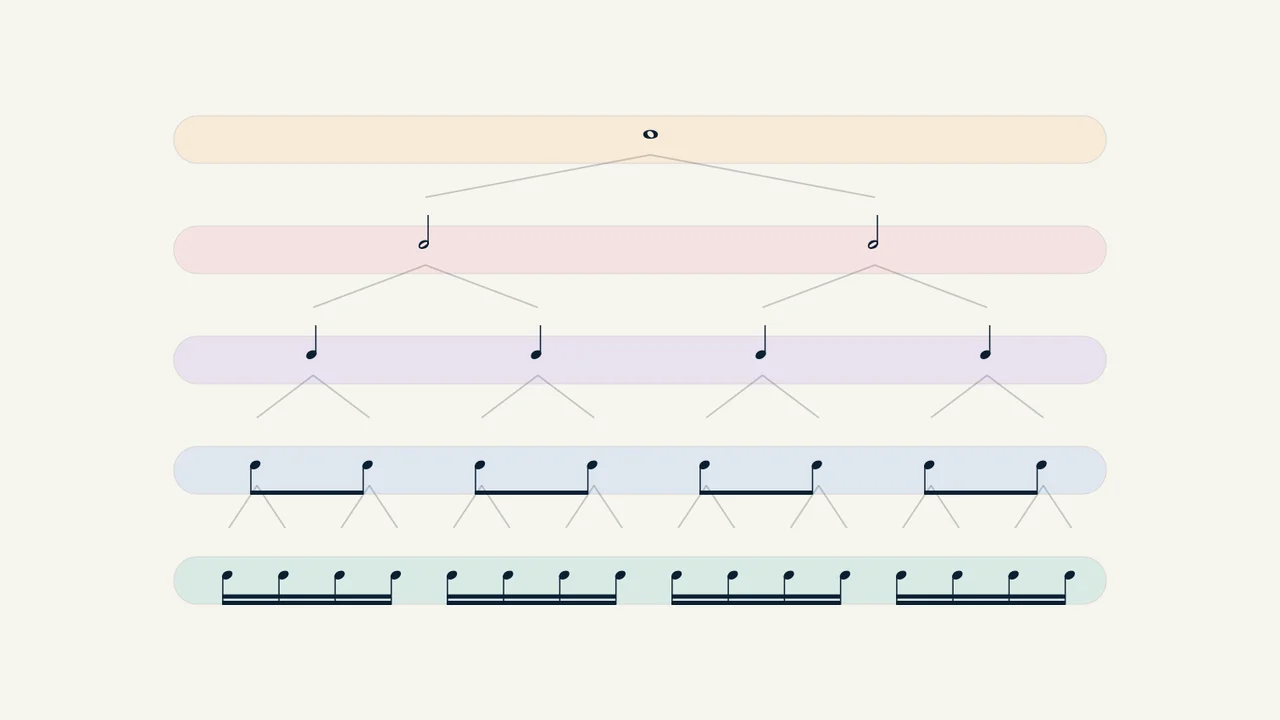
In 4/4 time, a whole note gets 4 beats, a half note gets 2 beats, a quarter note gets 1 beat, an eighth note gets half a beat and a sixteenth note gets a quarter of a beat. Each note value lasts half as long as the one before it, so two halves fill a whole, and one half note lasts as long as 2 quarter notes, 4 eighth notes or 8 sixteenth notes.
Those counts hold in any time signature with a 4 on the bottom (2/4, 3/4, 4/4), because the 4 says the quarter note is the beat. With a 2 or an 8 on the bottom, the same notes get different counts; the time signature section below works through 2/2 and 6/8. To feel how long “one beat” is before you read on, start the online metronome at 60 BPM (beats per minute): every click is one second, and one quarter note in 4/4.
| Note (US name) | UK name | Beats in 4/4 | How many fit in a whole note | Matching rest |
|---|---|---|---|---|
| Whole note | Semibreve | 4 | 1 | Whole rest |
| Half note | Minim | 2 | 2 | Half rest |
| Quarter note | Crotchet | 1 | 4 | Quarter rest |
| Eighth note | Quaver | ½ | 8 | Eighth rest |
| Sixteenth note | Semiquaver | ¼ | 16 | Sixteenth rest |
| Thirty-second note | Demisemiquaver | ⅛ | 32 | Thirty-second rest |
You can tell the values apart by their shape. A whole note is an open oval with no stem, and a half note is the same open oval with a stem added. A quarter note has a filled-in head and a stem. From the eighth note down, every halving adds one flag to the stem: one flag for an eighth, two for a sixteenth, three for a thirty-second. When several flagged notes sit next to each other, the flags are often drawn as beams that join the stems, with the same number of beams as the notes would have flags.
US names are fractions, UK names are older
The American names tell you the arithmetic. A half note is half of a whole note, a quarter note is a quarter of it, and a sixteenth note is one sixteenth of it. Read the name and you know how many fit in a whole note.
British English keeps older names: semibreve, minim, crotchet, quaver, semiquaver, demisemiquaver and hemidemisemiquaver (the sixty-fourth note). They don’t describe a fraction, so they have to be learned as a list. A dotted half note becomes a dotted minim, and a quarter rest becomes a crotchet rest. If you learn from British books or sit grade exams that use them, it helps to know both sets.
There is also a note longer than the whole note: the double whole note, or breve, which lasts 8 beats in 4/4. It is rare outside early music. Counted by length, the whole note down to the sixty-fourth note makes seven values. When someone asks about “the seven notes”, though, they often mean the seven letter names A to G, which name pitches.
The time signature decides what one beat means
A time signature has two numbers. The top one tells you how many counts are in each bar (also called a measure). The bottom one names the note that gets one count: 4 means the quarter note, 2 means the half note, 8 means the eighth note. Everything in the table above assumes that bottom number is 4.
2/2 (cut time)
In 2/2, the half note gets the beat. A half note is 1 beat, a whole note is 2 beats, a quarter note is ½ a beat and an eighth note is ¼ of a beat. A bar of 2/2 holds the same notes as a bar of 4/4; you just count two big beats instead of four small ones. It is often written as a C with a vertical line through it (¢), which is why it’s called cut time.
3/4
In 3/4, the quarter note still gets the beat, so every count from the table stays the same. There are three beats per bar, which means a dotted half note (3 beats) fills a whole bar. A whole note (4 beats) doesn’t fit in one bar of 3/4, so a sound that long has to be tied across the barline. A whole rest is the exception to the arithmetic: it means a full bar of silence in any time signature, so in 3/4 it stands for 3 beats of rest.
6/8
In 6/8, the bottom 8 makes the eighth note the counting unit, so there are six eighth-note counts per bar. A quarter note lasts 2 counts, a dotted quarter lasts 3, and a dotted half lasts all 6, a full bar.
6/8 is a compound meter, though, which means those six counts are grouped in threes: 1-2-3, 4-5-6. At most tempos you feel two beats per bar, and each felt beat is a dotted quarter note. So “how many beats is a dotted quarter note in 6/8?” has two correct answers depending on what you’re counting: 3 eighth-note counts, or 1 felt beat.
A half note in 6/8 lasts 4 counts, which cuts across the middle of the 3 + 3 grouping. That length is most often written as a dotted quarter tied to an eighth, so you can still see where the second beat starts.
Dotted notes: add half the value again
A dot after a note makes it one and a half times as long. Take the note’s value, add half of it, and you have the dotted value. In 4/4:
- Dotted whole note: 4 + 2 = 6 beats
- Dotted half note: 2 + 1 = 3 beats
- Dotted quarter note: 1 + ½ = 1½ beats
- Dotted eighth note: ½ + ¼ = ¾ of a beat
- Dotted sixteenth note: ¼ + ⅛ = ⅜ of a beat
The dotted half note answers a common question: which note is worth 3 beats? In 4/4 or 3/4, it’s the dotted half. In British English it’s called a dotted minim. To play one in 4/4, start the note on beat 1 and hold it while you count “1-2-3”; the next note comes in on beat 4.
The dotted quarter is the one that trips people up, because it doesn’t end on a beat. In 4/4 it often comes paired with an eighth note, and together they fill 2 beats. Count “1 & 2 &”: the dotted quarter sounds on 1 and holds through ”& 2”, and the eighth note lands on the ”&” of 2.
A second dot adds half of what the first dot added. A double-dotted note is one and three quarters times as long as the plain note:
- Double-dotted half note: 2 + 1 + ½ = 3½ beats
- Double-dotted quarter note: 1 + ½ + ¼ = 1¾ beats
- Double-dotted eighth note: ½ + ¼ + ⅛ = ⅞ of a beat
Dots work the same way on rests. A dotted quarter rest is 1½ beats of silence in 4/4.
Ties and dots: same length, different jobs
A tie is a curved line joining two notes of the same pitch. You play the first note and hold it for the length of both, without playing the second. A half note tied to a quarter note lasts 2 + 1 = 3 beats, as long as a dotted half note, and the two sound identical.
A tie can do three things a dot can’t:
- Cross a barline. A note that starts on beat 4 and holds into the next bar has to be tied, because each bar has to add up on its own.
- Make lengths no single note can. Plain and dotted notes jump from 2 beats (half) to 3 (dotted half) to 3½ (double-dotted half). A sound of 2½ beats needs a half note tied to an eighth.
- Keep the beat visible. The 6/8 half note above is the classic case: the tie shows where the second beat falls.
Don’t confuse a tie with a slur. Both are curved lines, but a slur connects notes of different pitches and asks you to play them connected (legato). A tie always joins two notes of the same pitch.
Rests use the same values
Every note value has a rest of the same length, listed in the table’s last column. A half rest is 2 beats of silence in 4/4, a quarter rest is 1 beat, and so on. The two longest rests look alike: the whole rest hangs below the fourth line of the staff, and the half rest sits on top of the middle line. A whole rest also marks a full bar of silence in any time signature. For how notes and rests combine into patterns, the guide to rhythm in music covers the bigger picture.
How to count note values out loud
Counting out loud keeps long notes from getting cut short and short notes from rushing. In 4/4:
- Quarter notes: “1, 2, 3, 4”, one count per note.
- Half notes: “1-2, 3-4”. Say both counts while the note holds.
- Whole note: “1-2-3-4” across the whole bar.
- Eighth notes: “1 & 2 & 3 & 4 &”, with the numbers on the beat and the ”&” halfway between.
- Sixteenth notes: “1 e & a 2 e & a…”, four syllables per beat.
In 6/8, count “1 2 3 4 5 6” and lean on 1 and 4. At faster tempos, switch to “1 & a, 2 & a”, which counts the two felt beats.
Triplets fit three notes into the space where two would go, so they don’t follow the halving pattern at all. They get their own guide: triplets in music.
A 10-minute note value practice routine
Counts stick once you clap them. This routine uses the metronome’s subdivision clicks and its silent beats, and takes about ten minutes.
- Quarters, halves, wholes (2 minutes). Set the metronome to 4/4 at 60 BPM. Clap once per click (quarter notes), then once every two clicks (half notes), then once per bar (whole notes). Count out loud the whole time.
- Eighths (2 minutes). Switch the subdivision to eighths so a softer click falls between the beats. Clap on every click and count “1 & 2 &”. At 60 BPM each eighth note lasts half a second, which is what half a beat sounds like.
- Sixteenths (2 minutes). Switch to sixteenths and count “1 e & a”. If it feels rushed, drop the tempo to 50 BPM.
- Hold through the silence (2 minutes). Back on plain beats, click beats 2 and 4 once each so they go silent. Clap half notes on 1 and 3 and keep counting through the gaps. If your next clap lands with the click, your half notes are the right length.
- Dotted halves and 6/8 (2 minutes). Switch to 3/4 and clap one dotted half note per bar. Then pick 6/8: the metronome clicks every eighth note with accents on 1 and 4. Clap only on the accents, and you’re clapping dotted quarter notes.
To see note values in a real score, open any MIDI file in MIDI to sheet music and name every value in the first four bars before you play them. Then try the dotted quarter and eighth pattern on the virtual piano, counting “1 & 2 &” as you play.
Common mix-ups
- Cutting held notes short. The counting stops inside a half or whole note, and the next note comes in early. Say every count of the held note.
- Treating the quarter note as one beat everywhere. In 2/2 the half note gets the beat, and in 6/8 the eighth note gets the count.
- Counting the dot as a whole beat. A dotted quarter is 1½ beats in 4/4. The dot adds half of the note it follows, which here is half a beat.
Note values are ratios
Each note value is half the one above it, a dot adds half again, and a tie adds two lengths together. With those three rules and the table at the top, you can work out the length of any plain, dotted or tied note in 4/4.
The symbols never change length relative to each other. A half note is always two quarter notes long, in every piece and every meter. The time signature decides which of them you call “one”, and once you know that, every other count follows.
Note values FAQ
How many beats does a half note get?
A half note gets 2 beats in any time signature with a 4 on the bottom, such as 4/4, 3/4 or 2/4. In 2/2 (cut time) it gets 1 beat, and in 6/8 it lasts 4 eighth-note counts.
Which note is worth 3 beats?
In 4/4 or 3/4, the dotted half note is worth 3 beats. A half note tied to a quarter note lasts the same 3 beats.
Is a quarter note always 1 beat?
Only when the bottom number of the time signature is 4. In 2/2 a quarter note is half a beat, and in 6/8 it lasts 2 eighth-note counts.
How many eighth notes are in a whole note?
Eight. A whole note also equals 2 half notes, 4 quarter notes or 16 sixteenth notes.
How many beats is a dotted quarter note?
In 4/4 a dotted quarter note lasts 1½ beats. In 6/8 it lasts 3 eighth-note counts, which is one felt beat.
What is a dotted half note called in British English?
A dotted minim. The half note is a minim in British English, and the quarter note is a crotchet.